

Wet
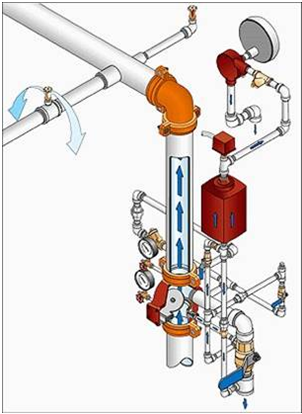 Wet sprinkler systems are the most common type of sprinkler system installed. A wet pipe system has water in the pipes in the ambient or normal condition and has heat responsive elements on all sprinklers. Thus, water is instantaneously discharged from a sprinkler when it activates.
Dry
 A dry sprinkler system is intended for use in areas where low temperatures could cause a wet pipe system to freeze. Dry pipe systems are pressurized with air in the ambient condition and experience an inherent delay in the discharge of water to allow the pressurized air in the system to escape. When a sprinkler activates, air is released through the sprinkler, allowing water to flow into the piping system through the dry pipe valve. NFPA 13 mandates that the time for water to reach the most remote sprinkler be no longer than 60 seconds. This time delay allows the fire to grow larger than it would with a wet pipe system of similar design, and the larger fire size results in more sprinklers in the fire area activating.
Pre-Action and Deluge
 Pre-action and deluge systems require fire detectors (smoke, heat, etc.) to activate.
A deluge system uses open sprinklers or nozzles to allow flow water discharge when the deluge valve activates. Deluge systems get used when the hazard is considered severe such as in occupancies with flammable liquid hazards where the fire could spread over a large floor area.
Pre-action systems have closed heads and pipes filled with pressurized air that supervise a piping system. They should be used to protect valuable assets and property. The detection system for a pre-action system can be designed to prevent water discharge in cases of a false alarm from the detection system, or in case of a sprinkler whose element has encountered mechanical damage.
The detection system on a pre-action system can be designed with a pre-action logic to meet one of the following objectives:
- Activation of a fire detector trips a deluge valve to admit water into the sprinkler piping to await the activation of a sprinkler.
- Activation of a fire detector or activation of a heat-responsive element on a sprinkler trips a deluge valve to allow water into the sprinkler piping.
- Activation of a fire detector and activation of a heat-responsive element on a sprinkler trips a deluge valve to allow water into the sprinkler piping.
What are some myths about automatic sprinkler systems?
Automatic Sprinkler System Myths
Sprinkler System Myths
MYTH: When a sprinkler system activates, all sprinklers on the system go off at the same time.
FACT: Each sprinkler has a heat-sensitive element with a predetermined temperature and sensitivity that responds to heat from a fire individually. Only those sprinklers in the immediate vicinity of the fire activate and discharge water. In most cases, only one sprinkler or two activate during a fire.
MYTH: Sprinkler systems cause excessive water damage.
FACT: In most cases, water flowing from a sprinkler causes much less damage than a fire would in the absence of a sprinkler. A fire could destroy an entire building, and it is important to have protective systems in place. Sprinkler systems have a solid performance record when it comes to saving lives and property, with minimal water damage. It is also important to note that the water damage from a fire hose operated by the fire service during firefighting operations in a non-sprinkled building could exceed the water damage from a sprinkler to a great extent because the rate of discharge from a fire hose is several times the rate of discharge from a sprinkler.
MYTH: Sprinkler systems don’t work.
FACT: Most studies of sprinkler system effectiveness show that sprinkler systems are between 98% and 99.8% effective in the control of fire. Most incidences regarding the ineffectiveness of sprinkler systems are related primarily to the failure of building owners to keep sprinkler control valves in the open position.
MYTH: Automatic fire detection systems are an acceptable substitute for sprinklers.
FACT: Automatic fire detection systems do not control or suppress a fire and are not a substitute for an automatic sprinkler system. Detection systems have a good record of providing notification but do not provide suppression.
MYTH: Accidental sprinkler discharge is common.
FACT: Sprinklers have an impressive history of reliable service in an emergency. Discharge from a sprinkler in the absence of a fire is very rare.
MYTH: Sprinkler systems cost too much.
FACT: Sprinkler systems are not prohibitively expensive. They usually cost only a small fraction of the total cost of a building. Usually, owners of a commercial property recover the cost of the sprinkler system in 5 to 10 years through insurance rate reductions. A residential sprinkler system connected to a public water system costs about $1.16 per square foot, less than the cost of most carpets.
MYTH: Sprinklers are ugly.
FACT: Sprinkler systems can be designed to maintain the beauty of a building by concealing pipes above ceilings or behind soffits. Also, there is a wide range of aesthetic models with a wide range of factory-applied colors available when it comes to selecting sprinklers. Ornamental and decorative sprinklers are available that allow concealment above the ceiling with only a small plate showing below the ceiling. The management of a building may choose to install sprinklers in plain sight even though they can be concealed to use it as a sales tool to emphasize life safety in a building, especially hotels.