

Fixed Temperature
Fixed Temperature Thermal Detectors can respond to the following:
- Fixed temperature limit
- Rapid rate of change of the temperature in the protected area
- Combination of these types of detection

Typical fixed temperature spot-type smoke detectors contain a bimetallic switch element that closes at a specified temperature limit. The switch is normally composed of two metals, each having a different temperature coefficient of expansion. As this bimetallic element heats the metal with the higher coefficient of expansion, it causes the switch to bend or curve, closing the switch; thus, indicating an alarm condition.
Line type thermal detectors are cables that detect heat along their entire length. A line type thermal detector may consist of two wires that are separated by an insulator. After the heat builds to a certain level the insulation melts, allowing the wires to touch and current to flow, initiating an alarm.
Bimetallic spot and coaxial style thermal detectors are self-restoring. Fusible link and melting insulation types of line thermal detectors are not self-restoring.
Advantages of Fixed Thermal detection:
- Lower cost than smoke detector units
- More reliable than smoke detector units
- Not affected by dusty or dirty environments
- Minimal maintenance
Disadvantages of Fixed Thermal detection:
- Slower to respond than smoke detectors
- Will not detect products of combustion
- Only suitable for protection of property
Rate of Rise
Rate-of-Rise Thermal Detectors measure the rate at which the air temperature changes during a fire event. Measuring the change in temperature provides a faster alarm response than measuring the temperature level in a space.
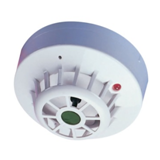 The rate-of-rise detector measures the change in the temperature of the space using a differential pressure switch. This switch contains an air chamber separated for the air in the ambient space by a flexible diaphragm. As the air in the ambient space changes temperature, the air pressure increases, creating a differential pressure across the diaphragm.
The air chamber is constructed with a calibrated leak so that normal temperature and pressure fluctuations within the room space adjust across both sides of the diaphragm and will not cause the alarm contacts to close. During a fire, the air temperature rises at a rate faster than normal, causing an increase on the room side of the diaphragm. The leak cannot compensate, and therefore the diaphragm moves and closes the detector contacts.
Combination rate-of-rise and fixed temperature thermal detectors are also manufactured and have in-built technologies.
Advantages of Rate-of-Rise Thermal detection:
- Responds faster than the fixed temperature detector
- Not affected by dusty or dirty environments
- More reliable than smoke detector units
- Less expensive than smoke detector units
- Minimal maintenance
Disadvantages of Rate-of-Rise Thermal detection:
- Slower to respond than smoke detectors
- Will not detect products of combustion
- Only suitable for protection of property
Rate Compensated
Rate-compensated thermal detectors are devices that are designed to activate at a predetermined temperature in a given space regardless of the rate at which temperature in the space increases. They work by compensating for the thermal lag between the room temperature and the interior temperature of the device.
The construction consists of an outer metal tube that expands at a fixed rate. Upon reaching a certain expansion distance, the alarm contacts within this tube start to close. However, the expansion is opposed by another metal device.
At a slow rate-of-rise in temperature, the outer tube begins to expand drawing the contacts closer together. The inner metal device exerts a counter force, keeping the contacts separated until the entire device heats to its rated temperature.
At a rapid rate-of-rise in temperature, the outer tube expands faster than the inner device can compensate. Therefore, the alarm contacts close when the entire device has been heated to a lower level, thus compensating for thermal lag.
Advantages of Rate Compensated Thermal detectors:
- Responds accurately and positively to fire threats
- Virtually eliminates false alarms
- Not affected by dusty or dirty environments
- More reliable than smoke detector
- Less expensive than smoke detector units
Disadvantages of Rate Compensated Thermal detectors:
- Slower to respond than smoke detectors
- Will not detect products of combustion
- Only suitable for protection of property